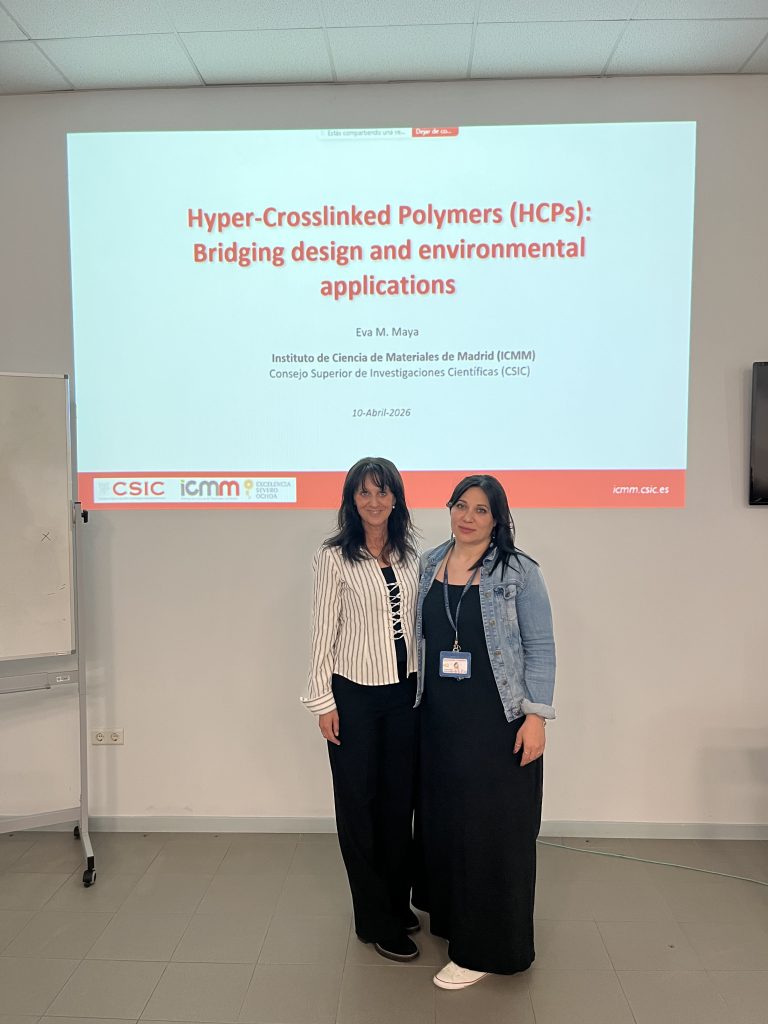
Last Friday, we welcomed Dr. Eva Maya to the IU CINQUIMA facilities. She is an expert in polymer technology at the Institute of Materials Science of Madrid (CSIC).
«Hyper-Crosslinked Polymers (HCPSs): Brinding design and evironmental applications»
Today’s world is facing a growing environmental crisis that demands urgent solutions if we want to preserve our planet. To move toward a more sustainable model, society must become aware of the challenge, and one of the sectors working most actively in this direction is scientific research—especially materials science. Developing new materials is essential to building a greener future: biodegradable plastics, storage systems for clean fuels, materials for renewable energies, greenhouse‑gas capture technologies, or catalysts for a greener chemical industry.
In this context, last Friday, April 10, we welcomed Dr. Eva M. Maya, a researcher at the Institute of Materials Science of Madrid (ICMM‑CSIC). Her scientific career focuses on the design and synthesis of porous polymers for environmental applications, and she has extensive experience in this field. She has authored 65 SCI publications, holds 7 patents, and has supervised 5 doctoral theses. She has also taken part in European projects such as CATCO2NVERS, aimed at developing catalysts to convert CO₂ into high value‑added products, including bioplastic precursors.
Hyper-crosslinked polymers: an emerging field
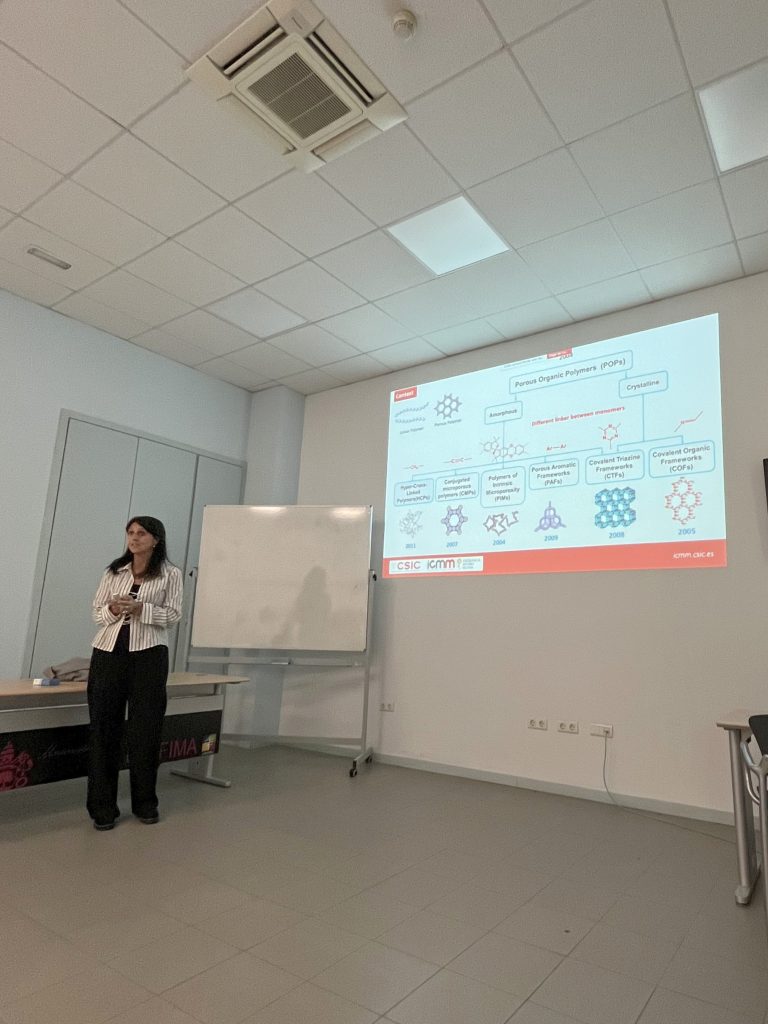
The talk given by Dr. Maya focused on hyper‑crosslinked polymers (HCPs), an emerging class of materials noted for their highly crosslinked and extremely porous structure. This architecture grants them valuable properties for sustainability‑related applications: very high surface area, strong thermal and chemical stability, the ability to adsorb gases and pollutants, and the option to introduce functional groups to tune their behavior. Their applications are wide‑ranging and particularly relevant to today’s environmental challenges, including CO₂ adsorption and capture, gas purification, pollutant removal, heterogeneous catalysis, and serving as supports for advanced materials.
She explained how her research team has managed to optimize the synthetic routes for these hyper‑crosslinked polymers. One of the most striking aspects is their work under high‑pressure conditions and the development of solid‑state polymerizations—processes that make it possible to limit solvent use to just a few milliliters or even eliminate it entirely, significantly reducing the environmental impact associated with producing these materials. Thanks to these strategies, they have succeeded in generating bio‑based polymers, as well as other materials capable of storing residual products from various chemical processes, enabling their subsequent conversion into value‑added compounds.
As part of the activities organized by the IU CINQUIMA, we usually welcome our guests with a casual coffee break—an informal gathering where the visiting researcher meets the institute’s PhD students. This relaxed setting serves almost as a first point of contact: they get to know each other, introduce themselves, discuss their research interests, and share anecdotes and everyday experiences from academic life.
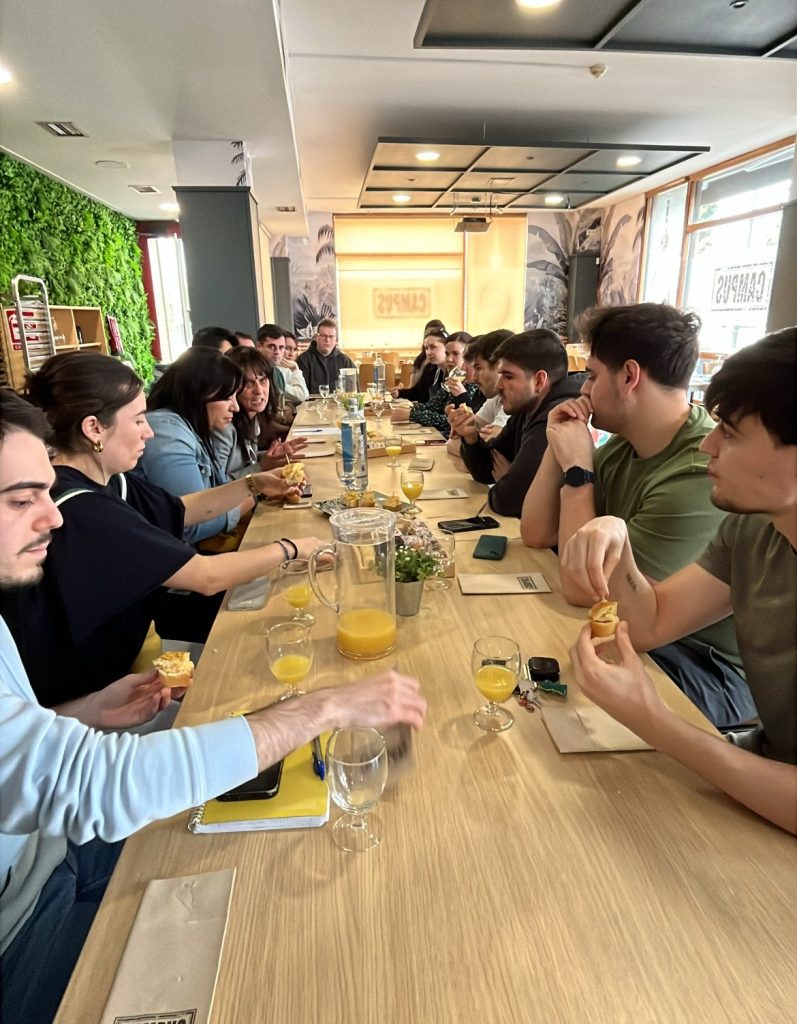
Although simple, this gathering is both valuable and genuinely engaging. It gives PhD students the chance to speak directly with established researchers, ask questions in a relaxed setting, and receive guidance that often doesn’t surface in formal seminars or lectures. At the same time, the guest researcher gets to learn about the work being carried out at our institute, gain fresh perspectives, and connect with the next generation of scientists.
The series of talks continues: next Monday the 20th, we will be welcoming Izaskun Jiménez‑Serra
We are once again welcoming a researcher from the CSIC, the country’s leading research institution. Izaskun Jiménez‑Serra, a scientist at the Centro de Astrobiología (CAB), will deliver a talk entitled “Towards prebiotic chemistry in the interstellar medium”.
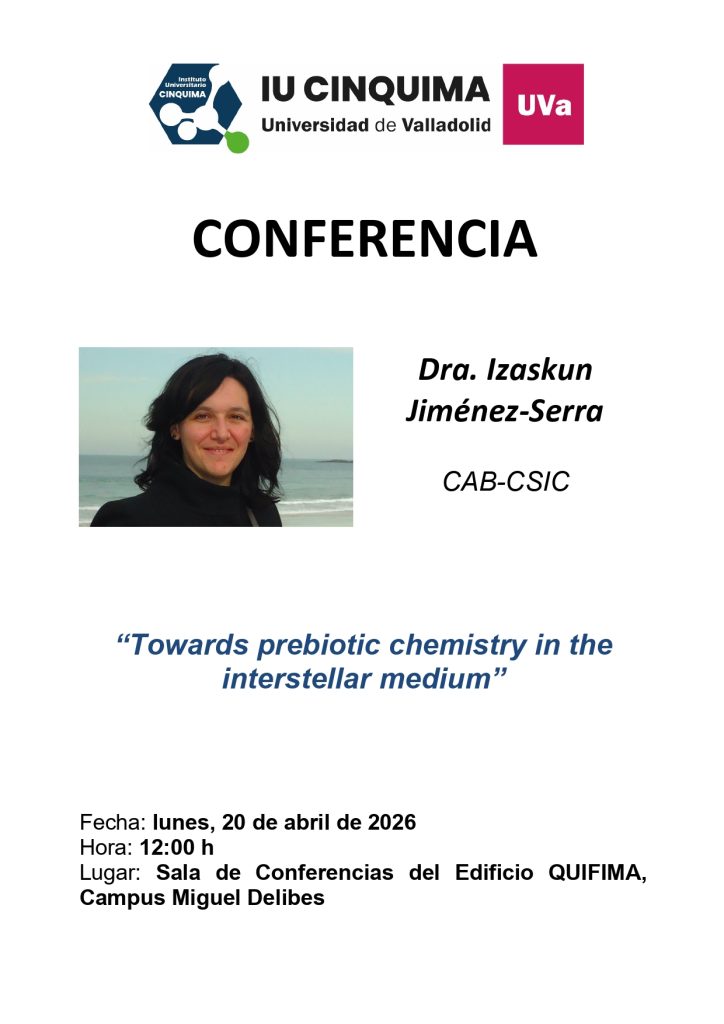
📅 Monday, April 20
🕛 12:00 PM
📍 Conference room (QUIFIMA building)